Public repositories
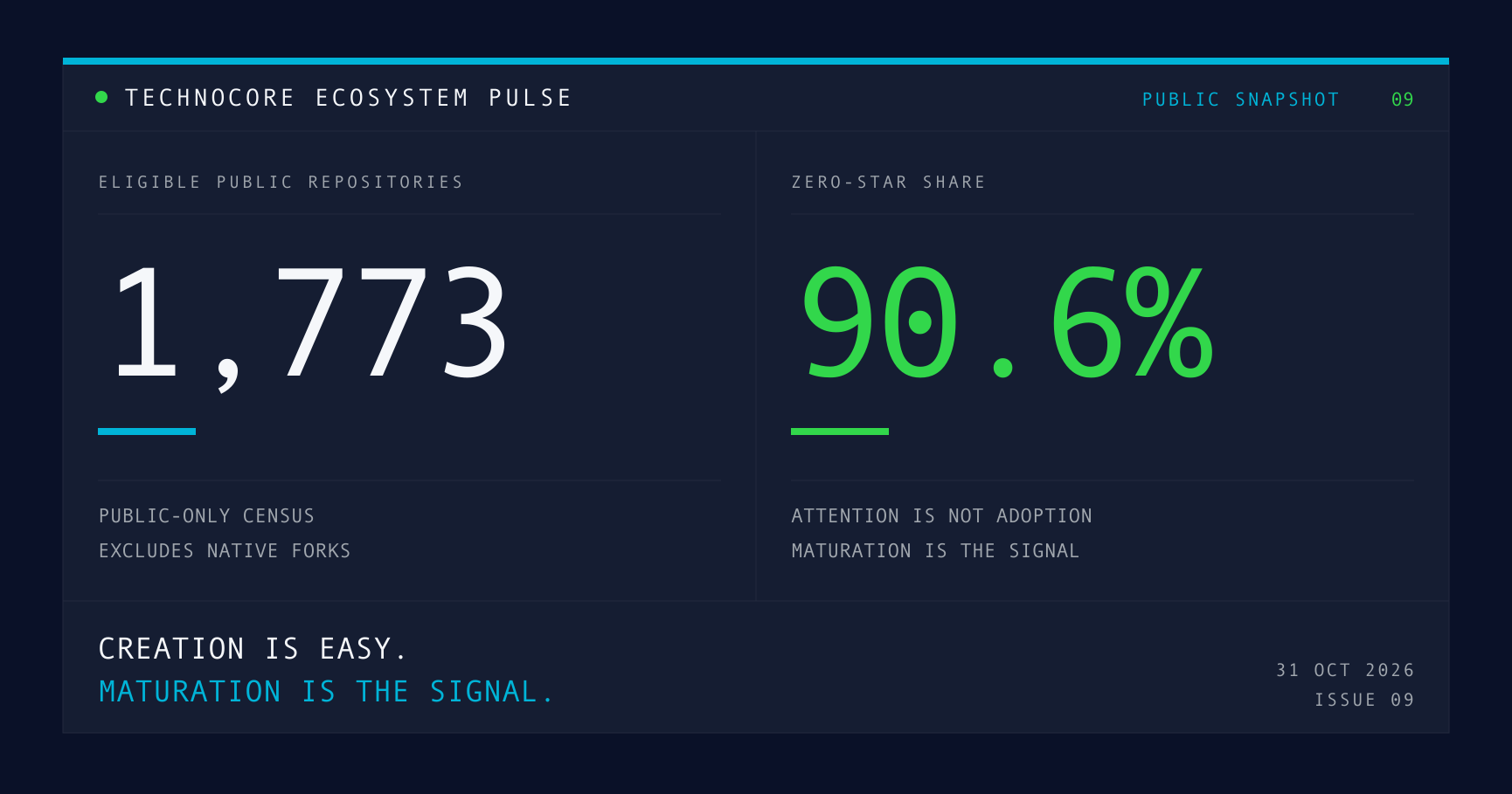
1,773
Eligible at the frozen census cutoff
Independent ecosystem intelligence · Issue 09
The public Technocore repository census recorded 0.1% net growth in seven days. The first-star cohort rose 2.5%, but the two-or-more-star cohort did not move; maintained public conformance, measurement, and settlement-check tools remain stronger signals than creation alone.
Eligible public repositories
1,773
90.6% have zero stars. Attention is not adoption.
Public repositories
1,773
Eligible at the frozen census cutoff
Zero-star repositories
1,606
90.6% of the public census
Repositories with stars
167
9.4% have at least one star
Since Issue 08
+1
+0.1% versus the 1,772-repository baseline
Issue-over-issue
Net census membership rose 0.1% from Issue 08. Repositories with at least one star rose 2.5%, while the smaller two-or-more-star cohort stayed at 56. None of those movements, by itself, establishes durable use.
Public census growth
Same search scope; GitHub-native forks excluded
Issue 0824 Oct
Issue 0931 Oct
Attention distribution
Only 167 repositories have received a star. Stars are an imperfect attention proxy—not maintenance, interoperability, or proof of use—but they expose how little work has crossed even the first discovery threshold.
Zero stars 1,606
One star 111
Two or more 56
Selected leading public projects
Current public GitHub counters at the frozen snapshot
Taxonomy audit
Issue 09 re-checked public READMEs for scripts and CLIs, heartbeat and readiness loops, watchers, cron jobs, snapshots, settlement, payments, and protocol conventions. New browser DID tooling and a devnet settlement-check runner remain bounded tools even when scheduled; the cron measurement and daily snapshot projects both refreshed on 31 Oct. No fourth category was materially missing.
Count once: every eligible public repository contributes one census record. Describe twice only when necessary: execution mode and capability are orthogonal, so a CLI may be schedulable without becoming a second project. Cards below show each representative repository in its primary public README role.
Covered · discrete execution
Tools that perform a bounded action—create a DID, sign, publish, inspect, verify, or export—and then terminate. Being schedulable does not automatically move a tool into the recurring lane.
Covered · recurring execution
Processes whose documented primary mode repeats: heartbeat or readiness loops, room watchers, scheduled measurements, and committed snapshots. This is an execution pattern, not a claim of autonomous intelligence.
Covered · protocol convention
Public specifications or convention layers that define interoperable frames, states, locks, receipts, or settlement interfaces. They remain distinct from a payment rail that actually holds value.
Protocol convention · public alpha
tclk/1 describes itself as a Technocore Lock Protocol convention layer for signed HTLC/PTLC deal messages, with a state machine and settlement-rail interface. Its public README still labels the project alpha: PaperRail settles nothing; FlopRail binds native FLOP typed escrow with devnet as the default, while testnet and mainnet remain planned upstream and configuration does not imply a live or audited deployment. The PTLC adaptor-signature path remains unaudited reference cryptography and is not Bitcoin-compatible. The public tclk-deals runner remains protocol rehearsal—not production settlement.
Separate public devnet evidence: flop-agent-runner ↗ documents gateway spend, on-chain settlement checks, and a public evidence export. Its README says the gateway broker—not the requesting agent—was credited on devnet, devnet earns nothing, and the direct-session operator pack is not public. This is proof-oriented tooling, not a production-volume metric.
Maturation evidence
These are examples of stronger public signals already present in the ecosystem. They are evidence categories, not additive project counts.
Community curation
GitHub returned 26 public, non-fork repositories created since 13 Aug with awesome-technocore in the name. Four representative indexes were re-checked for public visibility and recency; their linked-project union is not reported because every target’s visibility was not independently re-verified.
Reviewed indexes
Dates show the last public push visible at the snapshot. Inclusion is discovery evidence—not endorsement, verification, a security audit, or proof that every linked project remains public.
The vitality agenda
Repository creation is an acquisition metric. Ecosystem vitality is maintained compatibility plus independent use.
Publish shared fixtures and live probes; badges should lapse when a release stops matching the public protocol.
Give comparable credit for review, reproduction, issue triage, migrations, and maintenance—not only repository creation.
Merge public awesome lists into machine-readable metadata with project type, maintainer, test status, dependencies, and lifecycle stage.
Track service behavior, protocol drift, workflow failures, and stale integrations using reproducible public observations.
Count utility when a second independent DID installs, tests, depends on, or verifies a project with a public evidence trail.
What the public census cannot yet answer
UnavailableIndependent active adopters
UnavailableCross-client conformance rate
UnavailableMaintainer response-time trend
UnavailableProduction settlement volume